Dino King: Survival Idle
- 4.5
- Rating
- 1.00M
- Installs
- Free
- Price

 Analysis by App-foxy
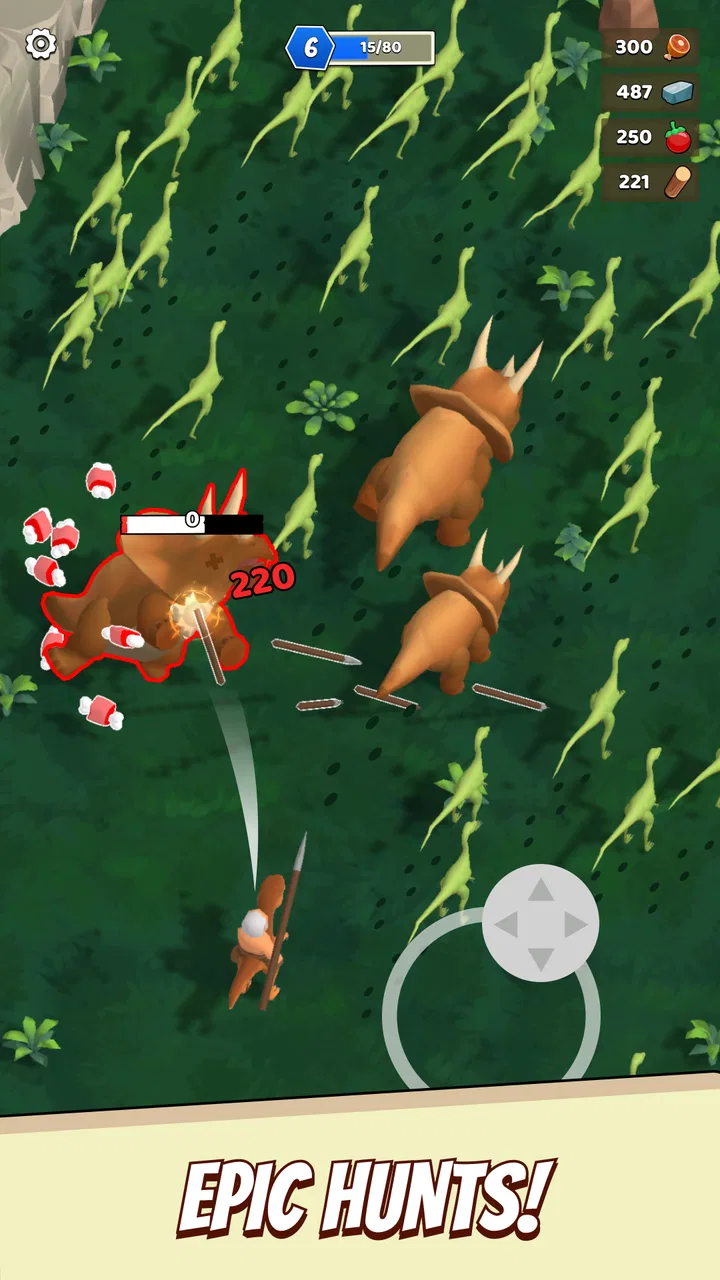
I spent my time with Dino King: Survival Idle as a light role-playing game built around one central idea: keeping a settlement alive while dinosaurs turn the surrounding world into a constant threat. That focus gives the game a clear identity. Instead of asking me to control every second of a battle, it makes the base itself the main project. I return, improve what I can, prepare for the next danger, and decide which upgrades are worth the cost.
That structure will appeal to players who enjoy gradual progress more than complicated controls. It is free to play, carries an Everyone age rating, and comes from Supercent, Inc. The game had a 4.4 average from around 3.6 thousand ratings when I reviewed it, with more than a million installs. Those figures suggest that its simple survival loop is reaching the right audience, although popularity does not remove the need to understand its limitations.
Why the base-building survival loop matters
The strongest capability here is the way the settlement turns idle progress into a survival decision. In many idle games, collecting resources can feel like a routine tap before the next reward. Here, the same routine has a more understandable purpose: the base needs to become stronger because the world outside is dangerous. That connection makes small improvements feel more meaningful than a simple number going up.
You May Also Like

 Blood Strike: 2.5 Anniversary
Blood Strike’s Loadouts Turn Every Drop Into a Tactical Gamble
A close look at Blood Strike’s custom loadouts: how fast access to signature weapons reshapes its battle royale rhythm, rewards preparation, and narrows the gap between fights.

 Pandora - Music & Podcasts
Pandora’s Music Is Easy to Start, but Harder to Recover
Pandora’s strength is its low-effort path from a seed to a station. Its weak spot is how much confidence it asks you to place in connection, setup, and quiet recovery.

 8 Ball Pool
 Is Built on Rivalries, Rematches, and Routine
A close look at the rivalries, rematches, shared routines, and unanswered safety questions that turn a quick pool match into a persistent mobile community.

 Samsung Music
’s Quiet Strength Is Playing What You Already Own
Its reach comes less from spectacle than from dependable access to a personal library. That simplicity is both the app’s strongest retention engine and its ceiling.

 AccuWeather: Weather Radar
AccuWeather Review: A Quick, Clear Forecast for Everyday Decisions
For everyday plans, the best forecast is the one you can understand quickly. AccuWeather makes rain timing, radar, and local conditions easy to act on, with a few trade-offs.

 Hill Climb Racing
Why Hill Climb Racing Still Turns Crashes Into One More Run
A tiny car, a bumpy hill and one more upgrade: Hill Climb Racing keeps resurfacing because its simple chaos makes every near-miss feel personal.
More From Our News Desk



I found myself thinking less about completing a long list of missions and more about the condition of the settlement. Should I improve the part that helps me grow faster, or spend resources on something that makes the next defensive challenge easier? That is a modest decision, but it gives the game a useful rhythm. The best moments come when an upgrade changes what I can handle rather than merely making the interface display a larger value.
The role-playing label is important, but this is not the kind of RPG I would choose for deep dialogue, exploration, or a large party of individually managed heroes. Its role-playing element is tied to progression and survival. The satisfaction comes from developing a stronger position over time, not from building a detailed narrative character.
The real appeal is the relationship between waiting and preparing. Idle progress gives me a reason to check back, while the defensive side gives those checks a practical goal. If I only wanted a completely passive experience, the survival pressure might feel unnecessary. If I wanted direct action every minute, the idle structure would probably feel too restrained.
How progress feels during an ordinary session
A typical session works best when I treat it as a short planning visit rather than a full gaming appointment. I open the game, collect what has accumulated, look at the next useful improvement, and decide whether the settlement is ready for another challenge. That makes it easy to fit into a brief break, especially when I do not want a game that demands uninterrupted attention.
The important habit is to avoid spending everything immediately. Saving for a meaningful improvement can be more useful than scattering resources across several minor changes. I also found that returning with a specific purpose made the game feel less repetitive. For example, I might check in because I want to strengthen the base before pushing forward, rather than opening it simply because a notification or routine suggested it.
This is where the game’s idle design helps and hurts at the same time. It reduces the pressure to play continuously, but it also means that some progress depends on patience. Players who enjoy watching a settlement develop gradually will understand the appeal. Players who expect every session to produce a dramatic new ability may find the pace conservative.
The survival theme gives the routine a little urgency, yet it does not turn every visit into a crisis. I can usually think through my next move instead of reacting to a fast action sequence. That makes it approachable for someone who likes management decisions but does not want a complex strategy interface.
A practical way to use the idle rhythm
My most useful approach was to separate progress into three questions. First, what is currently holding the settlement back? Second, which improvement addresses that problem directly? Third, am I spending resources because the upgrade is useful, or simply because it is available? This small checklist prevents the game from becoming a sequence of automatic taps.
It also helps to use the game in natural gaps during the day. If I have only a minute, I can collect progress and make one decision. If I have longer, I can look more carefully at the next defensive step. That flexibility is one of the better reasons to try it, but it depends on accepting that the game is designed around repeated short visits rather than one long, highly active campaign.
Another practical tip is to judge upgrades by their effect on the next obstacle, not by their appearance in the menu. A cheaper improvement that lets me move forward may be more valuable than an expensive upgrade that only increases a general resource flow. The game does not need a complicated spreadsheet to support this approach; it simply rewards paying attention to what the settlement actually needs.
The best everyday scenario
I think the strongest use case is a player who wants something to check during a commute, a lunch break, or a quiet moment at home. Imagine opening the game after being away, collecting the settlement’s accumulated progress, and finding that one defensive improvement is now within reach. The session can end after that decision, or continue if I want to see how the base handles the next stage.
That scenario shows why the game is more comfortable than a conventional action-focused dinosaur title for some players. I do not need to reserve a long block of time or maintain constant concentration. The game gives me a small project that can continue in the background of my day, while the survival theme keeps the project from feeling entirely abstract.
It is also a reasonable choice for someone new to role-playing games. The central goal is easy to understand: develop the base and survive the threats around it. There is less initial pressure than in a game that expects me to learn a large combat system, memorize character abilities, or follow a complicated story from the opening minutes.
On the other hand, I would not recommend it as the main game for someone who wants a cinematic dinosaur adventure. The premise suggests danger and spectacle, but the experience is more about progression management than dramatic discovery. The dinosaurs provide the setting and the reason to improve, while the base remains the real subject.
Where the trade-offs become noticeable
The first trade-off is control. Idle design is convenient because it lets progress continue without constant input, but convenience also removes some of the direct involvement that makes traditional RPGs exciting. I can make meaningful choices about development, yet I am not shaping every encounter moment by moment. That distinction matters more after the novelty of the theme wears off.
The second trade-off is repetition. The loop of collecting, upgrading, and preparing is clear, but clarity can become predictability. I recommend it to people who find satisfaction in incremental improvement. I would steer away from it if repeated resource cycles already feel like work in other idle games.
The third issue is monetization. The game is free to start, with optional in-app purchases ranging from $1.99 to $99.99 per item. That broad range means I would approach the purchase screen carefully. A player can enjoy the basic loop without assuming that every offer is necessary, but the presence of expensive options may make the progression feel less comfortable for anyone who dislikes spending pressure in free games.
My advice is to decide in advance whether the game is entertainment you want to sample casually or a long-term hobby worth paying for. If you are happy to progress patiently, the free entry point makes sense. If you dislike waiting and tend to buy boosts whenever progress slows, the overall cost can become harder to control. That is not a reason to reject the game automatically, but it is a reason to set boundaries before playing.
Device compatibility is fairly approachable: the current version is 1.3.0 and it requires Android 6.0 or later. I would still think about how often I want to play before installing it. A game built around repeated check-ins can become background clutter if I already have several similar titles competing for attention. Its value comes from the specific dinosaur-survival theme and the base-focused goal, not from being the only idle game available.
How it compares with familiar alternatives
Compared with a traditional role-playing game, this one asks for less active control and offers a lighter commitment. I do not choose it when I want a story-heavy adventure or detailed combat tactics. I choose it when I want the feeling of building strength over time without having to manage a large cast or spend every session in direct battles.
Compared with a pure idle clicker, the survival framing gives my upgrades a clearer context. The settlement is not just a machine for producing currency; it is the place I am trying to protect. That makes the theme more useful than decoration. Still, players who prefer completely frictionless idle games may find the defensive objective adds a little more planning than they want.
Compared with a base-building strategy game, the experience is easier to approach but likely less satisfying for someone who wants detailed diplomacy, complex layouts, or highly competitive decision-making. The appeal is not endless strategic depth. It is the compact loop of returning, improving, and seeing whether the settlement is ready for what comes next.
This is why I would not rank it as a universal replacement for other games in the category. It occupies a narrower space: a dinosaur-themed, survival-oriented idle RPG for players who like light management. When that description matches what I want, the focus works in its favor. When I want richer systems, another type of game would be a better use of my time.
Who will get the most from it
The best audience is someone who enjoys visible long-term progress and does not mind that progress arrives in steps. You will probably appreciate it if you like checking a base, choosing an upgrade, and gradually feeling more prepared. It is also suitable for casual players who want a free game that can be played in short sessions without requiring advanced RPG knowledge.
I would especially suggest it to people who enjoy dinosaur themes but are not necessarily looking for a direct action game. The dinosaurs create a distinctive reason to care about the settlement, while the idle format keeps the experience calm enough for everyday play. That combination is more specific than the store’s brief premise might suggest.
I would skip it if you need constant hands-on gameplay, a strong narrative, or precise control over every fight. I would also skip it if free-to-play purchase prompts tend to spoil your enjoyment, since the available item prices reach from small optional purchases to a much higher top end. Finally, if you already have an idle base-builder that you find difficult to keep up with, adding another similar routine may not improve your gaming life.
The Everyone rating makes it broadly approachable, but age suitability does not tell me whether the design matches a particular player’s patience. A younger or newer player may like the clear survival goal, while an experienced RPG fan may find the systems too light. The deciding factor is less age and more appetite for slow, structured progression.
My final take after building up the settlement
Dino King: Survival Idle works because it gives idle progression a concrete purpose. I am not only collecting resources for the sake of a higher total; I am using the settlement to face a dinosaur-filled survival problem. That connection is the game’s most effective idea, and it is strong enough to make short check-ins feel worthwhile.
It is not a deep replacement for a full role-playing adventure, nor is it the right pick for players who want nonstop action. The repetition, waiting, and purchase options are real considerations. Still, the free starting point, approachable structure, and clear base-building goal make it easy to recommend as a casual game for the right person.
My honest recommendation is to try it with a patient mindset. Set a spending limit, make upgrades with the next survival challenge in mind, and judge the experience by whether gradual improvement feels satisfying to you. If that rhythm sounds enjoyable, Supercent, Inc.’s dinosaur survival game has a focused loop that can fit neatly into everyday breaks. If you need constant novelty or deep control, it is better to choose a more active RPG instead.
FAQs for Dino King: Survival Idle
01What is Dino King: Survival Idle about?
Dino King: Survival Idle is an engaging mobile game where players take on the role of a dinosaur leader. Your goal is to build a thriving dino community, gather resources, and defend against predators. The idle mechanics allow the game to progress even when you're offline, making it perfect for casual gaming sessions.
02Is Dino King: Survival Idle free to play?
Yes, Dino King: Survival Idle is free to download and play. However, it does offer in-app purchases for various items and upgrades. These purchases can enhance your gameplay experience but are not necessary to enjoy the full game. Always check your device settings if you wish to restrict in-app purchases.
03What are the main features of Dino King: Survival Idle?
Dino King: Survival Idle offers a variety of features, including resource management, dino evolution, and strategic defenses. Players can unlock new species, upgrade habitats, and compete in events. The game also features vibrant graphics and an engaging storyline that keeps players interested as they progress.
04Can I play Dino King: Survival Idle offline?
Yes, one of the key advantages of Dino King: Survival Idle is its offline functionality. Players can continue to gather resources and progress in the game even when not connected to the internet. However, certain features, like multiplayer events and online competitions, require an active internet connection.
05What devices are compatible with Dino King: Survival Idle?
Dino King: Survival Idle is available for both Android and iOS devices. Ensure your device meets the minimum operating system requirements: Android 5.0 or higher, and iOS 10.0 or later. Check for updates regularly to enjoy the latest features and improvements in gameplay.
Pros
- Engaging dinosaur battles
- Intuitive idle gameplay
- Vibrant graphics
- Frequent updates
- Offline mode available
Cons
- In-app purchases can be pricey
- Limited customization options
- Occasional ad interruptions
- Requires stable internet for updates
- Some features locked behind paywall

Dino King: Survival Idle
Gallery